International trade in agricultural commodities is essential for ensuring food security, supporting economic growth, and providing consumers with access to diverse food products throughout the year. Every day, millions of tonnes of agricultural products—including fruits, vegetables, grains, livestock, meat, dairy products, seeds, and ornamental plants—cross international borders. While this trade generates enormous economic benefits, it also carries significant risks.
Agricultural commodities can serve as pathways for the introduction and spread of plant pests, animal diseases, and foodborne hazards. A single shipment carrying an invasive insect pest, contaminated food product, or infected animal can cause severe economic losses, threaten public health, and damage ecosystems.
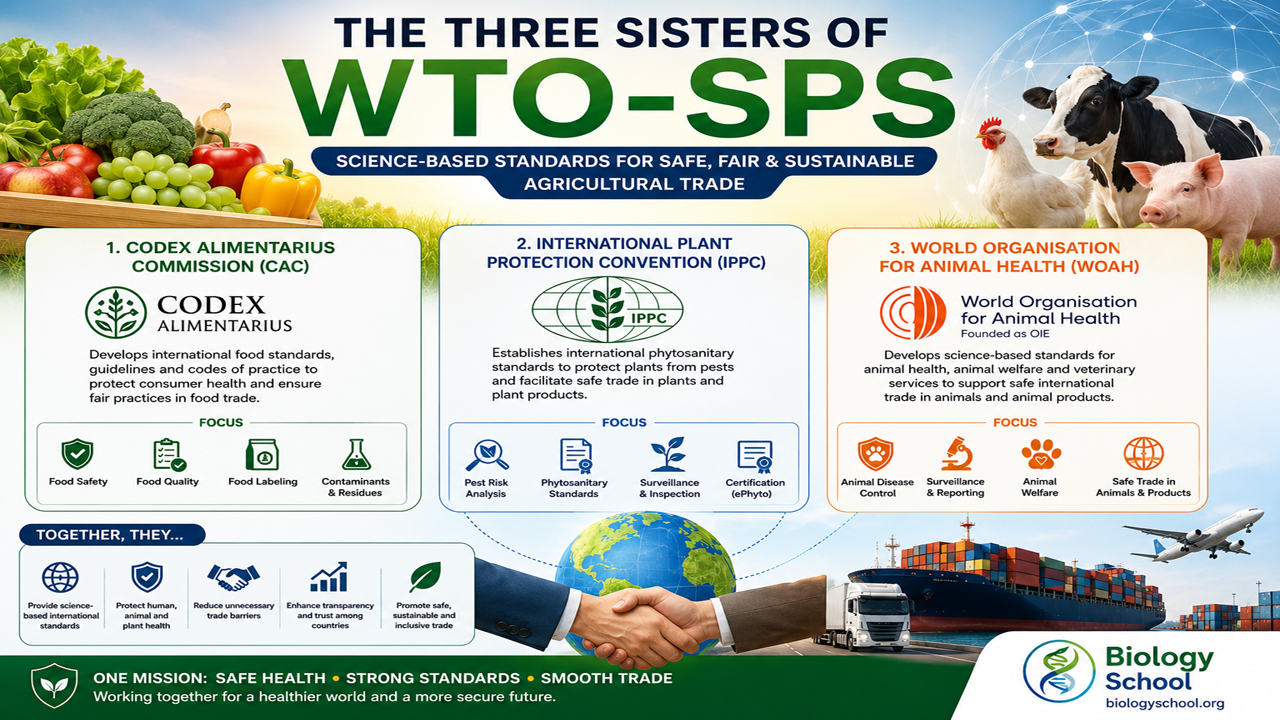
To address these risks while maintaining smooth international trade, countries rely on the World Trade Organization (WTO) Agreement on the Application of Sanitary and Phytosanitary Measures, commonly known as the SPS Agreement. At the heart of this agreement are three international standard-setting organizations often referred to as the “Three Sisters of WTO SPS”:
- Codex Alimentarius Commission (CAC)
- International Plant Protection Convention (IPPC)
- World Organisation for Animal Health (WOAH)
These organizations develop science-based standards that help countries protect human, animal, and plant health while facilitating fair and transparent international trade.
Understanding the WTO SPS Agreement
The WTO SPS Agreement entered into force in 1995 with the establishment of the WTO. Its primary objective is to ensure that governments can implement measures necessary to protect health without creating unjustified barriers to international trade.
The agreement covers measures related to:
- Food safety
- Animal health
- Plant health
- Prevention of pest and disease spread
- Protection against contaminants and toxins
A fundamental principle of the SPS Agreement is that measures should be based on scientific evidence and risk assessment.
To promote harmonization, the SPS Agreement recognizes standards developed by Codex, IPPC, and WOAH as international benchmarks for SPS measures.
Why Are They Called the “Three Sisters”?
The term “Three Sisters of WTO SPS” refers to the three international organizations whose standards are officially recognized under the WTO SPS Agreement.
Although each organization focuses on a different area of health protection, they share a common mission:
Protecting health while facilitating safe international trade.
Together they provide the scientific and technical foundation that allows countries to establish transparent, predictable, and science-based regulations.
-
Codex Alimentarius Commission (CAC)
Background
The Codex Alimentarius Commission was established in 1963 by the Food and Agriculture Organization (FAO) and the World Health Organization (WHO).
The term “Codex Alimentarius” means “Food Code” in Latin.
Codex develops international food standards, guidelines, and codes of practice designed to protect consumer health and ensure fair practices in food trade.
Major Functions
Codex develops standards related to:
- Food safety
- Food hygiene
- Food labeling
- Food additives
- Pesticide residues
- Veterinary drug residues
- Food contaminants
- Nutritional quality
Example of Codex Contribution
Suppose a country exports mangoes to another country. The importing country wants assurance that pesticide residues do not exceed safe levels.
Codex establishes Maximum Residue Limits (MRLs) for pesticides based on scientific risk assessments. These standards help both exporting and importing countries determine acceptable residue levels.
Without Codex standards, countries might apply inconsistent requirements, leading to trade disputes and barriers.
Contribution to Safe Agricultural Trade
Codex contributes by:
- Protecting consumers from unsafe food
- Harmonizing food safety regulations
- Reducing trade conflicts
- Supporting evidence-based food regulation
- Enhancing confidence in international food markets
Today, Codex standards influence food regulations in more than 180 countries.
-
International Plant Protection Convention (IPPC)
Background
The International Plant Protection Convention is an international treaty administered by the FAO.
Its primary objective is to protect global plant resources from the introduction and spread of pests.
The IPPC currently supports more than 180 contracting parties and serves as the global authority on plant health standards.
Major Functions
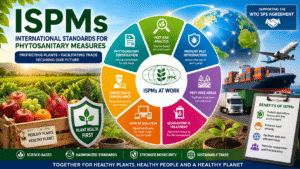
The IPPC develops International Standards for Phytosanitary Measures (ISPMs).
These standards cover:
- Pest Risk Analysis (PRA)
- Phytosanitary certification
- Surveillance and monitoring
- Import regulations
- Pest-free areas
- Inspection procedures
- Export certification systems
Example of IPPC Contribution
Consider a shipment of fresh oranges exported from one country to another.
The importing country may be concerned about fruit fly infestation.
Using IPPC standards, the exporting country can conduct surveillance, implement approved treatments, inspect consignments, and issue phytosanitary certificates that demonstrate compliance.
This science-based process protects agriculture while facilitating trade.
The ePhyto Revolution
One of the most significant recent achievements of the IPPC is the ePhyto Solution.
The ePhyto system allows electronic exchange of phytosanitary certificates between countries, reducing paperwork, preventing fraud, and accelerating trade.
Countries using ePhyto experience faster clearance procedures and greater transparency.
Contribution to Safe Agricultural Trade
The IPPC contributes by:
- Preventing the spread of invasive pests
- Protecting crop production
- Supporting agricultural exports
- Enhancing phytosanitary certification systems
- Facilitating safe trade in plants and plant products
Without IPPC standards, international movement of plants would pose much greater biosecurity risks.
-
World Organisation for Animal Health (WOAH)
Background
The World Organisation for Animal Health was established in 1924 and was formerly known as the Office International des Epizooties (OIE).
WOAH is recognized by the WTO SPS Agreement as the international standard-setting body for animal health.
Major Functions
WOAH develops standards related to:
- Animal diseases
- Animal welfare
- Veterinary services
- Zoonotic diseases
- Disease surveillance
- International animal trade
Example of WOAH Contribution
African Swine Fever (ASF) has caused major losses in pig populations worldwide.
WOAH provides internationally recognized guidelines for surveillance, diagnosis, reporting, and disease control.
These standards help countries manage disease outbreaks while minimizing unnecessary trade restrictions.
Contribution to Safe Agricultural Trade
WOAH contributes by:
- Preventing transboundary animal diseases
- Supporting animal welfare
- Protecting livestock industries
- Improving veterinary systems
- Facilitating safe trade in animals and animal products
Strong animal health systems are critical for maintaining food security and protecting rural livelihoods.
How the Three Sisters Work Together
Although Codex, IPPC, and WOAH have different mandates, their activities are closely interconnected.
For example, international poultry trade involves:
- WOAH standards for animal health
- Codex standards for food safety
- SPS measures based on WTO requirements
Similarly, exports of fresh fruits involve:
- IPPC phytosanitary standards
- Codex food safety standards
- WTO SPS transparency requirements
Together, these organizations create a comprehensive framework for safe agricultural trade.
Benefits for Developing Countries
Developing countries often face challenges in meeting international SPS requirements.
The Three Sisters help by providing:
- Technical guidance
- Training programs
- Capacity building initiatives
- Risk assessment tools
- Harmonized international standards
For countries such as Bangladesh, adopting international standards can improve export competitiveness and facilitate access to premium international markets.
Bangladesh Example
Bangladesh exports vegetables, fruits, fish, and agricultural products to international markets.
Compliance with Codex food safety standards, IPPC phytosanitary requirements, and WOAH animal health guidelines helps exporters meet importing country requirements and avoid trade disruptions.
Challenges Facing Global Agricultural Trade
Despite significant progress, several challenges remain:
Emerging Pests and Diseases
Climate change and globalization increase the risk of pest and disease movement.
Examples include:
- Fall Armyworm
- Red Palm Weevil
- African Swine Fever
- Avian Influenza
Food Safety Concerns
Consumers increasingly demand safer food with lower pesticide residues and greater traceability.
Digital Transformation
Countries must modernize inspection, certification, and surveillance systems to meet evolving trade requirements.
Resource Limitations
Many developing countries still face constraints in laboratory capacity, surveillance infrastructure, and technical expertise.
The Three Sisters continue to support countries in addressing these challenges.
Future Outlook
The future of safe agricultural trade will increasingly depend on science, technology, and international cooperation.
Emerging innovations such as:
- Electronic certification systems
- Artificial intelligence
- Digital traceability
- Genomic surveillance
- Big data analytics
will strengthen the ability of countries to manage SPS risks.
Codex, IPPC, and WOAH will remain central to developing standards that support these innovations while protecting health and facilitating trade.
Conclusion
The Three Sisters of WTO-SPS—Codex Alimentarius Commission, International Plant Protection Convention, and World Organisation for Animal Health—play a vital role in safeguarding global agricultural trade.
By developing science-based international standards for food safety, plant health, and animal health, these organizations help countries protect consumers, farmers, industries, and ecosystems while promoting fair and transparent trade.
Their collaborative efforts have created a robust international framework that enables agricultural commodities to move safely across borders, supporting global food security and economic development.
As international trade continues to expand and new challenges emerge, the importance of the Three Sisters will only continue to grow. Through science, cooperation, and harmonized standards, they remain fundamental pillars of safe, sustainable, and resilient agricultural trade worldwide.
Frequently Asked Questions (FAQs)
1. What are the Three Sisters of the WTO SPS Agreement?
The Three Sisters of the WTO SPS Agreement are the Codex Alimentarius Commission (CAC), the International Plant Protection Convention (IPPC), and the World Organisation for Animal Health (WOAH). These organizations develop international standards for food safety, plant health, and animal health, respectively.
2. Why are Codex, IPPC, and WOAH called the Three Sisters?
They are called the “Three Sisters” because the WTO SPS Agreement officially recognizes them as the international standard-setting organizations responsible for developing science-based standards that support safe agricultural trade and health protection worldwide.
3. What is the role of the Codex Alimentarius Commission (CAC)?
The Codex Alimentarius Commission develops international food safety standards, guidelines, and codes of practice. Its standards help protect consumer health and promote fair practices in international food trade.
4. What is the role of the International Plant Protection Convention (IPPC)?
The IPPC develops International Standards for Phytosanitary Measures (ISPMs) to prevent the introduction and spread of plant pests while facilitating safe trade in plants and plant products.
5. What is the role of the World Organisation for Animal Health (WOAH)?
WOAH develops international standards for animal health, animal welfare, veterinary services, and disease surveillance to facilitate safe trade in animals and animal products.
6. How do the Three Sisters contribute to safe agricultural trade?
The Three Sisters contribute by establishing harmonized, science-based international standards that help countries manage food safety risks, prevent the spread of pests and diseases, and reduce unnecessary trade barriers.
7. How are the Three Sisters linked to the WTO SPS Agreement?
The WTO SPS Agreement encourages member countries to base their sanitary and phytosanitary measures on international standards developed by Codex, IPPC, and WOAH. This promotes transparency, consistency, and fairness in global trade.
8. What are Sanitary and Phytosanitary (SPS) Measures?
SPS measures are regulations and procedures used by governments to protect human, animal, and plant health from risks associated with pests, diseases, contaminants, toxins, and foodborne hazards.
9. How does the IPPC support international plant trade?
The IPPC supports international plant trade through phytosanitary certification, pest risk analysis, surveillance systems, pest-free area recognition, and the development of International Standards for Phytosanitary Measures (ISPMs).
10. What is ePhyto and which organization manages it?
ePhyto is the electronic phytosanitary certification system developed under the IPPC framework. It enables secure electronic exchange of phytosanitary certificates between countries, reducing paperwork, fraud, and trade delays.
11. How does Codex help consumers?
Codex standards help ensure food safety by establishing limits for pesticide residues, food additives, contaminants, and hygiene requirements, thereby protecting consumers from unsafe food products.
12. How does WOAH help prevent animal disease outbreaks?
WOAH develops international standards for disease surveillance, reporting, diagnosis, prevention, and control of transboundary animal diseases such as avian influenza, foot-and-mouth disease, and African swine fever.
13. Why are international standards important for agricultural exports?
International standards provide a common framework that helps exporting countries meet importing country requirements, reduces trade disputes, and facilitates smoother market access.
14. How do the Three Sisters support developing countries?
The Three Sisters provide technical assistance, training programs, capacity building, risk assessment tools, and guidance documents that help developing countries strengthen their SPS systems and participate more effectively in international trade.
15. What is the future role of the Three Sisters in global agricultural trade?
As agricultural trade grows and new biosecurity challenges emerge, the Three Sisters will continue to develop science-based standards, promote digital innovations such as ePhyto, strengthen food safety systems, and support sustainable and resilient global trade.